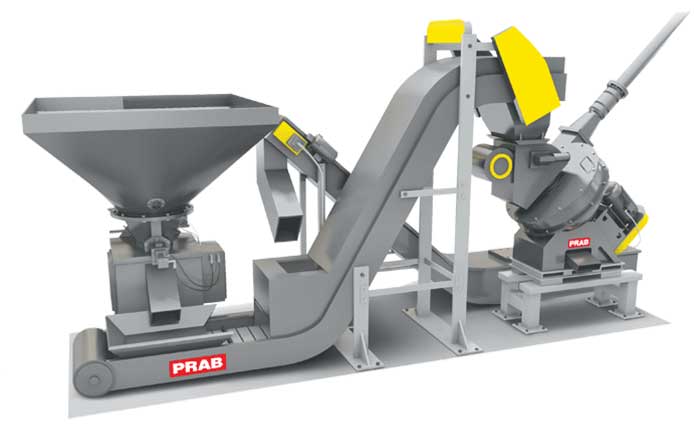


Metal chip processing systems reduce stringy turnings and bushy wads from machining into flowable chips, then spin them in a wringer (centrifuge) to separate cutting fluid for reuse. PRAB builds three configurations: Crusher/Wringer for large bundles and stringy turnings, Shredder/Wringer for loose turnings, and the skid-mounted E-Series for small- to medium-volume applications.
Dry, flowable chips are worth more to a recycler than wet, tangled turnings, and the coolant you spin out is coolant you do not have to buy again. That is the case for chip processing in one sentence. PRAB turning and chip processing systems automate the work of getting there, so operators spend less time handling metal scrap and your plant stores and hauls less of it.
The process starts with volume reduction. Long turnings from milling, drilling, screw machines and Swiss machines have to be crushed or shredded down to thumbnail-size chips before anything else can happen. Once the material flows, a wringer separates the fluid and the chips come out dry.
“Our original process was very labor intensive and required constant attention. It was not effective, far from automatic, and it certainly didn’t fit with our philosophy of having a clean, environmentally-friendly shop.”
Gary Sroufe, C&A Tool
The right configuration depends on what your turnings look like and how much of them you produce. Use the table as a starting point.
| Crusher/Wringer | Shredder/Wringer | E-Series | |
|---|---|---|---|
| Best for | Large bundles, bulky wads and stringy turnings | Loose metal turnings | Small to medium volumes of short turnings and chips |
| Volume reduction | Vertical axis crusher, up to 90% | Shredder with stainless steel cutter discs | Conveyor-mounted shredder, up to 4 to 1 |
| Fluid recovery | Up to 99% of coolants and cutting oils | Up to 99% of coolants and cutting oils | Up to 98% of fluids |
| Throughput | |||
| Installation | Compact skid, pre-wired and pre-plumbed, with forklift pockets |
Built for the hard material: large bundles and stringy turnings that will not flow on their own. The crusher breaks them down, and the wringer delivers dry, shovel-grade chips while reclaiming up to 99% of coolants and cutting oils.
Turns loose metal turnings into flowable chips, then separates the fluid. You get dry chips and reclaim up to 99% of coolants and cutting oils in one continuous process.
A compact, skid-mounted system that handles volume reduction and solid-liquid separation for small to medium volumes. It is the usual choice for smaller shops that want fluid reclamation and dry chips without a large installation.
Not sure which one fits? PRAB tests customer material in its test lab and uses the results to select components and layout. Request a material test.
The E-Series is a fully automated, skid-mounted system for small- to medium-volume material handling. It processes most short turnings and chips from machining in six steps.
The E-Series is built from wear-resistant material, runs on PLC/HMI controls, and ships pre-wired and pre-plumbed on a skid. Integrated forklift pockets let operators set it up or relocate it quickly. Paired with a Guardian, PRAB reports reductions in new fluid purchases of up to 75% and in fluid disposal costs of up to 90%.
Aluminum turnings are among the most difficult materials to process, especially in large volumes. A PRAB high-volume aluminum system moves wet, stringy material from the loader to dry chips in storage without manual handling in between.
Each system is configured from PRAB’s standard heavy-duty components to fit your material, volume and floor space. Lab testing on your material determines which ones go in.
Related equipment: Metal Scrap Briquetters and Modular Chip Processing Systems.
A crusher is the heavy-duty option. It breaks large bundles, bulky wads and stringy turnings into chips and can reduce scrap volume up to 90%. A shredder uses high-torque, low-speed shearing to turn loose turnings and light to moderate wads into flowable chips. PRAB runs your material in its test lab to determine which one your application needs.
A chip wringer, also called a chip spinner or chip centrifuge, spins metal chips at more than 600 Gs of centrifugal force. Cutting fluid passes through a screen and drains to a recovery tank. The dry chips are then released pneumatically or carried away by a conveyor.
PRAB Crusher/Wringer and Shredder/Wringer systems reclaim up to 99% of coolants and cutting oils from chips. The E-Series wringer removes up to 98% of fluids. Reclaimed fluid can be pumped to a PRAB Guardian Coolant Recycling System for cleaning and reuse.
The E-Series. It is a compact, skid-mounted system built for small to medium volumes of turnings and chips. It arrives pre-wired and pre-plumbed, and integrated forklift pockets let operators set it up or move it quickly.
Yes. Aluminum turnings are among the most difficult materials to process in large volumes, and PRAB builds high-volume aluminum systems that crush, wring, magnetically separate and pneumatically convey chips to storage.
A wringer produces dry, loose, flowable chips. A briquetter compresses chips and turnings into dense briquettes. The better choice depends on how your scrap buyer pays, how much storage space you have and how far the scrap has to travel. PRAB builds both. See Metal Scrap Briquetters.
Payback depends on your scrap volume, the metal you machine, what you pay for cutting fluid and what you spend on hauling and labor. PRAB’s Chip Processing ROI Calculator estimates the return using your own numbers.
Yes. PRAB tests customer material in its test lab and uses the results to select components and layout. You can request a material test before you commit to a system.
PRAB chip processing systems are covered by the Performantee® Guarantee. To see what the numbers look like for your operation, use the Chip Processing ROI Calculator.
PRAB Briquetter E-Series Metal Chip Processing System 3D Operation
The PRAB E-Series System provides metalworking operations a fully automated compact, skid-mounted chip processing solution that is proven to increase scrap value by 25%. Here’s how it works: A screw conveyor meter-feeds metal scrap to the system’s conveyor-mounted shedder. The shredder reduces light to moderate wads of turnings with high torque, low speed shearing generating flowable chips at a volume reduction up to 4 to 1. Material then flows through the tramp metal separator, removing occasional solids. Chips are blown into the system’s continuous wringer and tramp metal falls into a separate hopper. The Wringer/Centrifuge uses 600 G’s of centrifugal force to remove up to 98% of fluids, creating dry chips. PRAB’s Wringer/Centrifuge utilizes an exclusive reversing feature to extend service life and minimize maintenance. The metalworking fluids pass through the screen while the dry chips are gravity discharged into the discharge conveyor. Fines are recirculated back into the system for additional processing. The E-Series is designed for small to medium material volumes and can process most machining metal short turnings and chips. The system’s recovery tank captures the reclaimed fluid, where it can be pumped to a PRAB Guardian™ Coolant Recycling System for processing and reuse. The Guardian reduces new fluid purchases up to 75% and decreases fluid disposal costs by 90%. Built to last, the E-Series from PRAB is constructed of the highest quality wear resistant material, features PLC/HMI controls, and is virtually plug-and-play: pre-wired, pre-plumbed and mounted on a skid. The system’s integrated forklift pockets enable operators to quickly and easily set up or move the E-Series Chip Processing System.
PRAB High Volume Aluminum Systems
Aluminum turnings are one of the most difficult types of material to process, especially in large volumes. PRAB delivers the reliable, durable, and dependable aluminum processing system your operations demand. The skid steer loader feeds wet, stringy material into the hopper of the 6” pitch steel belt conveyor. The PRAB Steel Belt Conveyor carries the material up and meters it into the crusher. The crusher reduces the stringy chips into smaller, flowable chips and discharges them onto the PRAB Drag Conveyor. The PRAB Drag Conveyor transports the material up and into two diagonal shaft chip wringers. The PRAB Chip Wringers separate the coolant from the chips using nearly 700 Gs of centrifugal force. The settling tank captures the coolant for recycling. An integral PRAB Drag Conveyor discharges the settled fines back into the material flow. The PRAB Chip Wringers internally generate air pressure to pneumatically discharge dry chips. The dry chips travel through the pneumatic piping and cyclones to the PRAB Magnetic Separator. The PRAB Magnetic Separator removes ferrous particles from the stream of material and discharges them into a container, while dry aluminum chips continue onto the weight belt. The weigh belt measures throughput of dry material in process and deposits it into a blower. The blower pneumatically transports the chips across the plant to one or more cyclones, which dissipate the air and deposit the chips into storage bunkers.
Product Brochures
Product Brochure: Turning & Metal Chip Processing Systems
Product Brochure: Diagonal-Shaft Wringer
Product Brochure: Drag Conveyor
Product Brochure: E-Series Chip System
Product Brochure: Horizontal Axis Crusher
Product Brochure: Metal Turnings Shredder
Product Brochure: Vertical Axis Crusher
Case Studies
Case Study: Chip and Fluid Recovery at Mathews, Inc.
White Paper
White Paper: Avoiding Accidents, Injuries & Illnesses In Metalworking Operations
White Paper: Getting the Most Value from Metal Scrap and Spent Fluids
White Paper: Green Engineering
White Paper: Reallocating Labor in the Metalworking Industry
White Paper: Reducing Haul-Away Costs in Metalworking Operations
Other Downloadable Content
PRAB Chip Processing Systems All Product Brochure
PRAB Builds Equipment for the Toughest Jobs in Manufacturing and Metalworking
CHALLENGE Kalamazoo, Mich., July 20, 2014 – Featured in Modern Machine Shop Magazine. Mathews, Inc is a manufacturer of Bows and Archery Equipment. The company has been in business since 1992 starting with 26 people, growing to now over 400 full-time employees. Another recent expansion to a new 56,000 sq ft facility provided the added capacity necessary to […]
According to the Aerospace Industries Association, few if any industries have done a better job of improving environmental performance over the last several decades than the aerospace industry. The AIA states that today’s aircraft and engines are considerably more efficient than those manufactured just 20 or 30 years ago, which has dramatically decreased fuel usage and harmful emissions. Additionally, […]
Download Conveyors Still Operating in the Field After 57 YearsExclusive Bolt-Free Connections for Staying Strong Under Grueling ConditionsEvery part of this rugged chain driven conveyor is designed for handling severe duty, highly abrasive, wet metal chips, fines and swarf. The heavy-duty, abrasion-resistant flight bars feature an exclusive bolt-free connection for staying strong under grueling conditions. The abrasion-resistant […]

 (800) 968-7722
 (800) 493-3462