Published October 16, 2026
Water costs and disposal fees keep climbing, and the regulations governing what you can release aren’t getting any looser. This is the first of two posts in our Industrial Process Water and Reuse Systems 101 series, built for facility and environmental managers who want to get ahead of both. This post covers the fundamentals. A companion post, Industrial Process Water and Reuse Systems 102, compares specific system types, case studies, and ROI analysis for your own facility.
Quick Answer
Industrial wastewater treatment systems combine ultrafiltration, reverse osmosis, vacuum evaporation, and automated pH adjustment in turnkey configurations to meet EPA and POTW discharge requirements while enabling water reuse. Documented results include up to 90% reductions in wastewater volume and disposal costs, with return on investment typically achieved in 12 to 18 months. For manufacturers targeting zero liquid discharge, vacuum evaporation can recover up to 99% of wastewater as reusable distillate.
→ See how a PV panel manufacturer reached ZLD and resold its treated byproduct
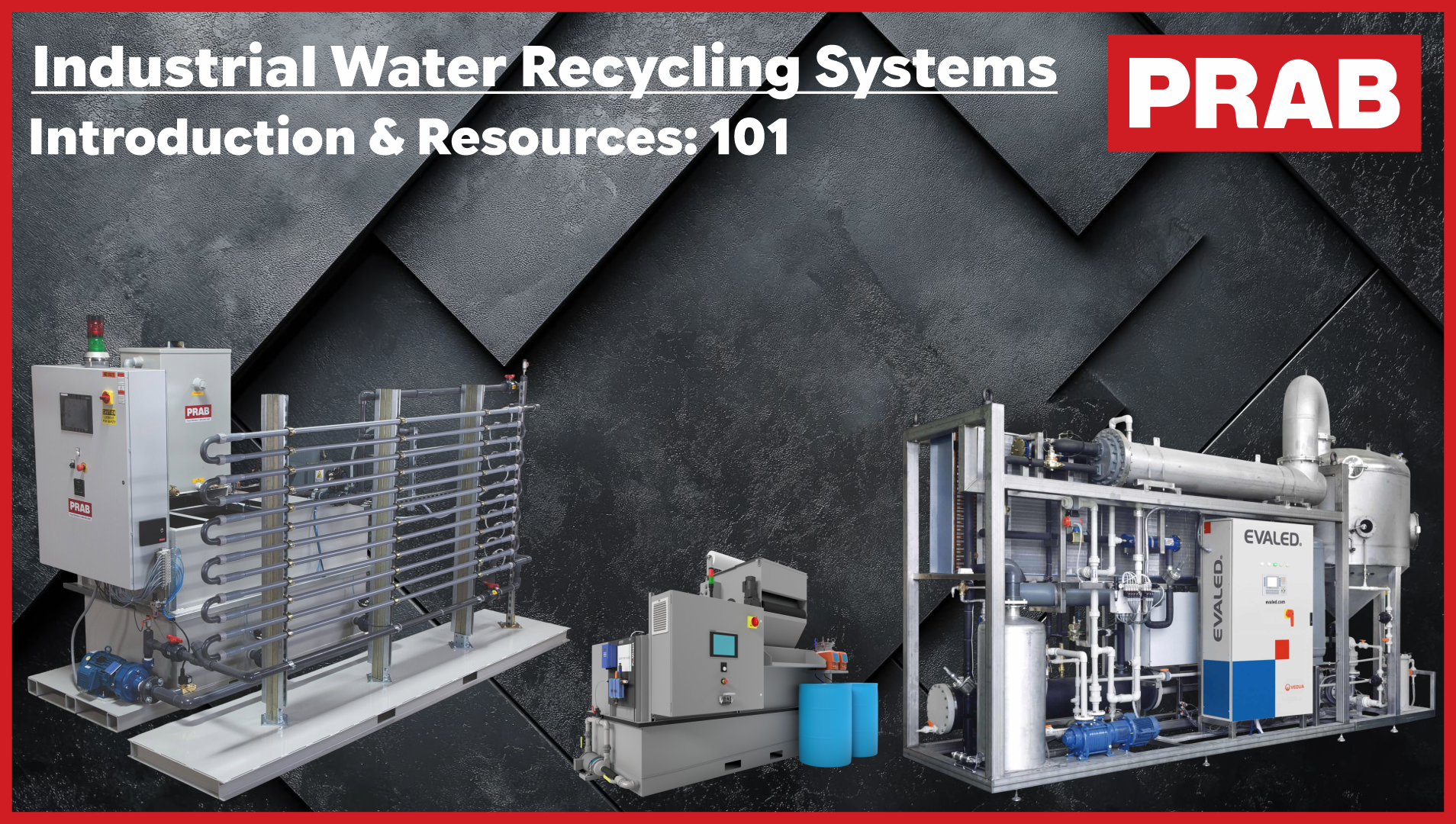 Ask most manufacturing plant managers about their process water and you’ll hear the same story: it worked fine for years, then a permit renewal, a rate hike from the local sewer authority, or a failed compliance audit turned it into an urgent problem. Process water treatment sits at an odd intersection of environmental regulation and plain operating cost, and both sides of that equation have gotten more expensive in recent years.
Industrial wastewater treatment systems address both pressures at once. Done well, they reduce the volume of water a facility has to buy, treat, and haul away, while also keeping effluent within the pH and contaminant limits that the EPA and local Publicly Owned Treatment Works, or POTWs, require before releasing anything to a sewer. Facilities running integrated ultrafiltration, reverse osmosis, and pH adjustment systems have documented reductions of up to 90% in wastewater volume, up to 75% in detergent costs, and up to 90% in disposal costs, with most installations paying for themselves within 12 to 18 months.
Most manufacturers assume wastewater treatment means a single machine doing a single job. In practice, effective wastewater compliance solutions combine several distinct technologies, each targeting a different category of contaminant:
Systems come as standalone units or as a single skid-mounted, turnkey package. Which combination makes sense depends entirely on what’s actually in your wastewater, which is why site-specific analysis of flow rate, composition, and reuse goals has to come before equipment selection, not after.
Zero liquid discharge, or ZLD, gets used loosely in industry conversation, so it’s worth being precise about what it means: no liquid waste leaves the facility at all. Everything gets recovered, reused, or reduced to a solid residue for disposal. That’s a meaningfully higher bar than standard treatment, and it’s usually pursued for one of two reasons: a facility operates in a water-scarce region where fresh water is expensive or restricted, or the wastewater is expensive enough to treat and dispose of that recovering it outright beats paying for both water and disposal.
Vacuum evaporation is the technology that actually gets facilities to ZLD. It concentrates high-strength wastewater, recovers usable distillate, and leaves behind a smaller residue for disposal, recovering up to 99% of the original fluid volume as reusable distillate. Plating operations, aerospace manufacturers, and battery recyclers are among the heaviest users of this approach, largely because their waste streams are either too concentrated or too regulated to be treated with membrane filtration alone.
Of all the compliance requirements a manufacturer faces, pH is the one that trips up most facilities, mostly because it’s continuous rather than periodic. EPA pretreatment regulations under 40 CFR §403.5(b)(2) require industrial wastewater released to a POTW to stay between pH 6.0 and 9.0, with anything below pH 5.0 categorically prohibited as corrosive hazardous waste. That’s not a target you hit once during an audit. It’s a range that every batch has to clear before release.
Automated pH adjustment systems solve this by dosing acid or caustic reagent based on live sensor feedback rather than a fixed schedule, verifying each batch against the required range before it’s released and logging pH, volume, and timestamp for every event. That logging matters as much as the treatment itself. Most POTW violations trace back not to a single bad batch but to missing or incomplete discharge records, which is exactly the kind of gap automated compliance reporting is built to close.
Manufacturers evaluating industrial water treatment tend to focus on compliance first and cost second, but cost is usually what makes the equipment pay for itself. Reduced water purchases, lower chemical usage from tighter pH control, and fewer hauling trips all show up on the same balance sheet as avoided fines. One documented ultrafiltration installation reduced detergent costs by up to 75% and haul-away costs by up to 90%, numbers large enough that the equipment’s ROI has nothing to do with avoiding regulatory risk.
Facilities that combine multiple technologies, such as UF feeding into RO or automated pH adjustment ahead of an oil-water separator, tend to see the largest combined savings, since each stage reduces the load on the next. An oil-water separator that removes free-floating oil early, for example, extends the life of downstream UF membranes considerably, thereby lowering both maintenance costs and replacement frequency.
Because wastewater composition varies so much by industry and even by shift, sizing a system off a generic spec sheet is risky. Free fluid testing on your actual wastewater, before any equipment purchase, confirms solids removal performance, filtration clarity, and expected throughput so the system you install matches what’s actually coming out of your process, not an industry average. That testing, backed by a performance guarantee, is the difference between installing equipment that hits its documented numbers and installing equipment that becomes the next compliance problem.
What pH range is required for POTW discharge compliance?
EPA pretreatment regulations under 40 CFR §403.5(b)(2) require a pH between 6.0 and 9.0 for wastewater released to a Publicly Owned Treatment Works. Discharges below pH 5.0 are categorically prohibited as corrosive hazardous waste.
What’s the difference between process water treatment and industrial wastewater treatment?
Process water treatment addresses fluid reuse in manufacturing processes, such as rinsing, washing, and cooling. Industrial wastewater treatment specifically targets the effluent leaving the facility for discharge, ensuring it meets EPA and POTW limits before entering the sewer system.
Can a facility actually reach zero liquid discharge?
Yes, primarily through vacuum evaporation combined with membrane pre-treatment. Facilities using this approach have recovered up to 99% of their wastewater as reusable distillate, leaving only a small concentrated residue to manage.
White Papers
Case Studies
Deeper Guide
For CFOs and Owners
Product Line: Explore Industrial Process Water and Reuse Systems
Not sure which treatment combination fits your discharge and reuse goals?
Continue this topic: Industrial Process Water and Reuse Systems 102, comparing UF, RO, evaporation, and pH control.
New to this series? Start from the front end of the process with Metal Scrap Conveyors 101 to see how scrap and fluid move through a facility from the machine tool onward.
About the Author: Paul Montgomery is the Marketing Leader at PRAB, Inc., a Kalamazoo, Michigan-based industrial equipment manufacturer. He has more than 20 years of B2B marketing leadership experience, including CMO and VP roles across industrial manufacturing, SaaS, and InsurTech, and has driven revenue growth of up to 300% year-over-year. At PRAB, he leads digital strategy, content, and demand generation across the company’s industrial wastewater treatment, fluid recycling, conveyor, and chip processing product lines.


 (800) 968-7722
 (800) 493-3462